- Get link
- X
- Other Apps
Introduction
Vision plays a crucial role in our daily lives, but for
some people, standard glasses or contact lenses are not enough to achieve
clear, single vision. One condition that makes vision difficult is double
vision, medically known as diplopia. Traditionally,
prism glasses have been prescribed to help align images seen by both eyes.
However, many patients today are turning to an advanced option—prism
contact lenses.
These specialized lenses combine the benefits of modern
contact lens technology with prism correction, offering a more natural and
comfortable way to address double vision and related visual disorders.
In this article, we’ll explore what prism contact lenses
are, how they work, who can benefit from them, and why they may be the best
solution for patients dealing with complex eye conditions.
What Are Prism Contact Lenses?
Prism contact lenses are custom-made specialty lenses designed to correct double vision
by bending light before it enters the eye. They work similarly to prism glasses
but with a major advantage—they rest directly on the eye’s surface, providing a
wider field of view and improved comfort compared to glasses.
Unlike standard contact lenses that simply correct
refractive errors like nearsightedness or farsightedness, prism
contact lenses address misalignment between the two eyes.
By incorporating prism power into the lens, they bring the two images into
alignment, reducing or eliminating double vision.
How Do Prism Contact Lenses Work?
The human brain relies on both eyes working together to
create a single, clear image. When the eyes are not perfectly aligned, the
brain receives two different images, leading to diplopia.
Prism lenses shift
the direction of light as it enters the eye, essentially moving the image so
both eyes can see it in the same place. When applied in contact lenses:
1.
Custom Alignment – Each lens is tailored to the patient’s unique eye structure and
degree of misalignment.
2.
Seamless Correction – Instead of looking through a limited prism area in glasses,
contact lenses provide full-field correction.
3.
Comfortable Vision – Lenses sit directly on the cornea or sclera, ensuring consistent
correction without the distortion or thickness of prism glasses.
Conditions Treated with Prism Contact Lenses
Prism contact lenses are highly effective for patients
with:
·
Binocular Diplopia
(Double Vision): Misalignment between eyes
leading to two images.
·
Strabismus: Eye muscle imbalance, sometimes corrected with prism lenses.
·
Nerve Palsies: Weakness or paralysis in the eye muscles, often resulting in
misalignment.
·
Post-Surgical Cases: Patients recovering from eye or brain surgery may need prism
correction.
·
Convergence
Insufficiency: Difficulty in focusing both
eyes at near distances.
For patients with monocular diplopia
(double vision from one eye due to corneal irregularities), scleral lenses with
prism can be designed to create a smooth optical surface and correct alignment
simultaneously.
Benefits of Prism Contact Lenses
Switching from prism glasses to prism contact lenses offers
multiple advantages:
1.
Wider Visual Field – No frames or restricted zones like glasses.
2.
Better Comfort – Especially for patients needing high prism correction, lenses
eliminate thick and heavy glasses.
3.
Natural Appearance – Contacts are invisible, unlike prism glasses that can appear
bulky.
4.
Improved Consistency – Lenses remain stable on the eye, ensuring constant correction.
5.
Custom Precision – Advanced technology like scleral mapping and 3D scanning allows
ultra-precise fitting, sometimes within microns of accuracy.
The Role of Scleral Prism Contact Lenses
One of the most exciting developments is the use of scleral
lenses with prism correction. Unlike soft or rigid gas permeable
lenses, scleral lenses vault over the cornea and rest on the sclera (the white
part of the eye). This allows them to:
·
Correct both corneal
irregularities and misalignment at the same time.
·
Incorporate prism without
compromising comfort.
·
Stay stable due to their larger
size, reducing lens movement.
Advanced mapping technology allows eye doctors to design
scleral prism lenses with up to 240,000 data points, ensuring
a perfect match for the patient’s unique eye anatomy.
Who Is a Candidate for Prism Contact Lenses?
Not everyone with double vision requires prism contact
lenses, but ideal candidates include:
·
Patients with high prism needs
that glasses cannot comfortably manage.
·
Individuals with irregular
corneas plus binocular vision issues.
·
Those seeking a cosmetic
alternative to thick prism glasses.
·
Patients with persistent
diplopia not corrected by other treatments.
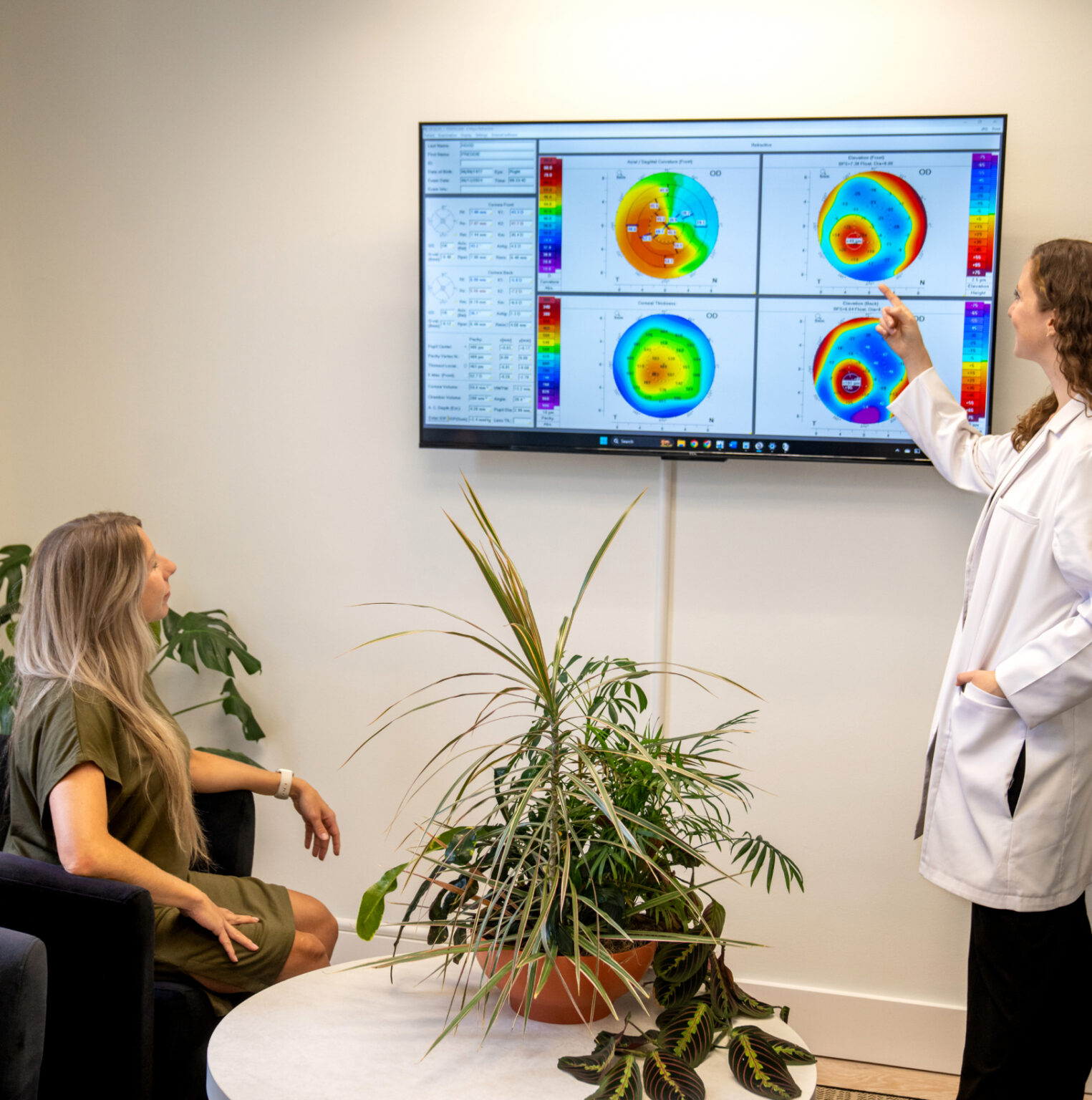
A consultation with a specialty contact lens doctor is the
best way to determine suitability. During the exam, advanced diagnostic tools
such as Pentacam imaging and OCT scans may be
used to measure eye shape, misalignment, and corneal irregularities.
What to Expect During a Prism Lens Fitting
1.
Comprehensive Eye Exam – To diagnose the cause of double vision.
2.
Measurements &
Mapping – 3D scans and imaging to capture
precise eye details.
3.
Trial Lens Application – Doctors may place diagnostic scleral or hybrid lenses with prism
to test correction.
4.
Custom Lens Design – Data is sent to a lab where lenses are manufactured with exact
prism power.
5.
Follow-Up Adjustments – Fine-tuning ensures the best vision and comfort.
Most patients adapt quickly, though it may take a few days
to adjust to seeing with prism contact lenses.
Cost and Accessibility
Since prism contact
lenses are highly specialized, they may be more expensive than
standard contact lenses. However, many clinics offer:
·
Payment plans
·
Insurance coverage (in
some cases)
·
Options like
CareCredit™, HSA, and FSA
Given their life-changing benefits, many patients find the
investment worthwhile.
Conclusion
Prism contact lenses are revolutionizing the way double vision and eye misalignment are
treated. By combining the corrective power of prism optics with the precision
of modern specialty contact lens technology, they provide clearer, more
comfortable, and more natural vision than prism glasses.
For patients struggling with double vision, eye muscle
imbalances, or corneal irregularities, prism contact lenses can offer a
customized and highly effective solution. Consulting a specialty contact lens
doctor is the first step toward regaining clear, single vision—and reclaiming
quality of life.
Comments
Post a Comment